

The different types of tongue cleaners, why and how to use them
Tongue scrapers and cleaners have been used since ancient times in China and India. Although many different styles of tongue scrapers and tongue brushes have been developed, the main purpose of a tongue cleaner has remained the same: to remove the bacteria, dead cells, and food particles that the tongue collects.
The surface of the tongue is covered with papillae and taste buds, which provide an excellent breeding ground for bacteria. Not only does this bacteria cause bad breath, but if the tongue is not cleansed, the bacteria will spread to other areas of the mouth such as the teeth and gums. This can cause dental problems including tooth decay, gum infections, and gum recession.
Recently, dentists and hygienists have carried out studies showing that regular cleaning of the tongue improves dental health and drastically reduces bad breath.
- Why use a tongue cleaner?
- Types of tongue cleaners
- How to use a tongue brush or tongue scraper
- Do you clean your tongue before or after brushing your teeth?
Why use a tongue cleaner?
Tongue bacteria is the main source of bad breath.
Do you have a white tongue, or have you ever looked at your tongue and seen a white film on it? This white stuff is actually a buildup of bacteria, food particles, dead cells, and even fungi. These decaying bacteria produce volatile sulfur compounds, which cause the bad odor in bad breath. Because of this, it is very important to regularly cleanse your tongue of these odor-producing bacteria, along with the food particles and dead cells that act as fuel for them.
According to dental researchers, “tongue bacteria account for 80 to 90 percent of all cases of halitosis (bad breath).” In the remaining 10 to 20% of cases, the bad breath originates from the tonsils, the stomach, decaying food stuck between the teeth, tooth decay, or plaque buildup on the teeth. If it is even remotely accurate that 80-90% of bad breath originates from bacteria on the tongue, then you had better be cleaning and sanitizing your tongue of these bacteria if you want to get rid of bad breath.
Here at BreathMD, we believe that cleaning your tongue with a tongue scraper is the quickest, most effective, and easiest way to reduce halitosis. Many people do not own a tongue scraper, and the only cleaning their tongue gets is from mouthwash, which is not very effective at removing tongue bacteria or particles. Clinical studies have shown that daily use of tongue cleaners has a significant effect on removing bacteria and reducing foul odors from one’s mouth.
Types of tongue cleaners
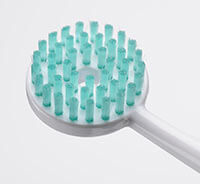
Essentially, there are two types of tongue cleaners: tongue brushes and tongue scrapers. Tongue brushes are effective at loosening particles and bacteria that may be lodged between the papillae and taste buds that cover the surface of the tongue. Tongue scrapers are more effective at gathering bacteria and particles from the tongue and removing them from the mouth.
A toothbrush may be used as a tongue brush. We find that toothbrushes with soft bristles work better than toothbrushes with thick, rigid bristles.
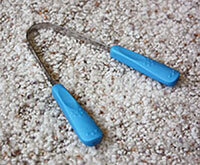
Tongue Scraper
Tongue Brush
There are some tongue cleaners that incorporate a scraper and a brush such as the Orabrush. While those brush-and-scraper combos are convenient, I find that they do a poor job of both scraping and brushing. The saying “jack of all trades, master of none” applies to them.
When purchasing tongue cleaners, it may be a good idea to buy a couple of different styles (since they are so cheap) and see what works best for you.
BreathMD’s favorites: After trying many tongue brushes and scrapers, we have personally settled on the “Tongue Cleaner” as a tongue scraper and Dr. Collins Perio Toothbrush or another toothbrush with the new ultra-fine tapered style bristles as a tongue brush.
How to use a tongue brush or tongue scraper
First of all, there are various tongue brushes and tongue scrapers, so you should follow the instructions that come with yours.
For tongue brushes, use gentle back-and-forth strokes on the surface of the tongue, and remember to go as far back as you can. After you feel you have done a thorough job, swish some water in your mouth for 10 seconds and spit it out to remove all the tongue bacteria and material that the brushing loosened. For additional cleaning, you can now use a tongue scraper to remove the loosened material even better. If you use both a tongue scraper and a tongue brush, remember to brush your tongue first, then scrape.
For tongue scrapers, you generally start at the back of the tongue and scrape all the white gunk forward. Rinse the collected gunk off your tongue scraper several times while cleaning your tongue. Continue using gentle strokes to scrape your tongue until it collects little or no white material.
Here are some general tips to ensure that you use a tongue cleaner effectively.
-
Be gentle - It is important to be gentle when scraping or brushing your tongue. Do not press too hard. The tongue is a sensitive organ, and daily abusive scraping is not good for it. Using gentle strokes is just as effective.
-
Rinse before and after use - The tongue cleaner comes in contact with the bacteria of the tongue. It is important to rinse the bacteria off after cleaning the tongue and also to rinse before cleaning the tongue because bacteria or dust may have settled on the cleaner since the last use and you do not want that bacteria or dust in your mouth.
-
Use a paste -
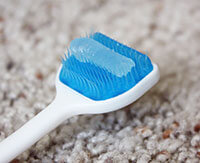 You can try using a paste on your tongue brush or tongue scraper. Options include toothpaste, a paste of salt and baking soda, or gels formulated for the tongue. See what you like best.
 -
Scrape all areas of the tongue - It is easy to just scrape the central area of the tongue and neglect the sides. Scrape near the edges as well.
-
Scrape as far back as you can - The majority of the tongue bacteria that cause bad breath reside far back on the tongue near the throat. Try to scrape as far back as you can in order to reach that bacteria. I find it very important to be even more gentle while scraping back there, since it is more sensitive. Also be sure not to accidentally jab or poke your tonsils with the tongue scraper. I once accidentally jabbed one of my tonsils with my tongue scraper while they were swollen because I happened to be sick; it started bleeding, got infected, and made me even sicker. Learn from me and be careful.
Do you clean your tongue before or after brushing your teeth?
That is a good question; unfortunately, few studies have determined which order is most effective. So once again, you should try both and test it out for yourself. I personally like to clean my tongue before brushing my teeth, but that is just my preference. Either way, the tongue needs to be cleaned, so don’t neglect it in your oral care regimen.