
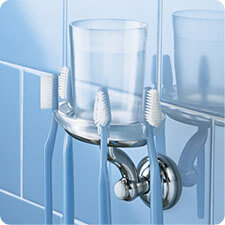
A discussion of what works and what doesn’t for storing a toothbrush and keeping it clean
No matter what toothpaste or mouthwash you use, it will be hard to have fresh breath and good oral health if your toothbrush is overrun with bacteria, mold, and decaying food particles. A clean toothbrush in good condition is essential for good oral hygiene and for killing the germs that cause bad breath. Many myths and ideas surround how to keep your toothbrush clean and free of bacteria and other particles, such as storing it as far away from the toilet as possible or in a closed container. Some of these are important and effective for maintaining good health, while others are unnecessary, not worth the time, or just plain too expensive. In this article we will discuss proven methods that keep your toothbrush clean and working well, and we will also explain why other methods may be too much work for too little result.
- Cleaning and Storing Basics
- Do toothbrush sanitizers work?
- Deep cleaning and Sanitizing a toothbrush
- Storing the toothbrush by the toilet
- What to do with your toothbrush if you’re sick
Cleaning and Storing Basics
This is a list of the things that work best for keeping your toothbrush clean and effective.
Rinse it
The easiest way to keep your toothbrush clean is to rinse it with hot water (hot water cleans and kills germs more easily) before and after brushing. Move your thumb back and forth against the bristles while they are under running water. It is important to rinse before brushing as well as after, because airborne bacteria or other particles such as dust may have settled on the toothbrush since your last brushing.
Dry it
The bacteria that cause gum disease are anaerobic. That means they live in a low-oxygen environment, so they are killed by exposure to air. The simple act of letting your toothbrush dry between brushings will kill many bacteria. Do not store your toothbrush in a covered container, where it does not get adequate ventilation. The bristles also tend to touch the walls of a closed container, and that will contaminate the toothbrush unless the container has just been cleaned.
Store it upright
Storing your toothbrush upright (bristles up, handle down) after use is very important. This lets the water drain from the bristles more easily, so the water and particles collect at the bottom of the handle instead. You may also notice that a nasty scum collects at the bottom of containers that have no drain, and you do not want your bristles touching that scum, which could cause them to collect mold and bacteria.
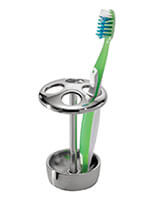
What is the best toothbrush holder?
The best holder is one that holds the toothbrush upright, has good ventilation, and keeps the brushes from touching each other so as to prevent cross-contamination. Some people may prefer toothbrush stands that suspend the brush or that have a drain in the bottom to prevent the buildup of scum and stagnant water. Remember to clean your toothbrush holder regularly. I clean mine once a week, at the same time I deep clean my toothbrush.
Don’t swap
It is usually common sense for adults not to swap toothbrushes, but young children need to be taught which toothbrush is theirs and to use only that one. Color coding or writing names on the toothbrushes will help. When people use each other’s toothbrushes, they also swap each other’s germs, which can easily cause sickness.
Replace regularly
The ADA (American Dental Association) recommends replacing your toothbrush with a new one every 3-4 months. Personally, I think that is way too long. If you take your time as you brush and brush three times a day, the bristles should be looking pretty haggard after about a month. Once the bristles get frayed and bent, the effectiveness of the toothbrush drops drastically. Once your toothbrush isn’t performing as well as it used to, it is time to replace it.
Do toothbrush sanitizers work?
Many products on the market now claim to sanitize your toothbrush and kill all of its bacteria. There are antibacterial rinses and UV (ultraviolet) light sanitizers, and some toothbrushes even have antibacterial bristles. Do they work? Some do a good job of killing bacteria, while others do not live up to their claims. A better question is: Is completely sanitizing a toothbrush every time even necessary? Studies have shown that some of these products do kill bacteria, but not a single study shows that using a toothbrush sanitizer reduces your risk of getting sick.
Keep in mind that your mouth is swarming with bacteria, but only a small percentage of them are considered pathogenic (able to cause disease). Your toothbrush will almost never be completely free of germs, and that’s okay. Many germs don’t affect your health at all. In my opinion, these new sanitizers are more trouble than they are worth: they cost money, are usually harder to clean, and just aren’t necessary.
Deep cleaning and sanitizing a toothbrush
Do not boil or microwave your toothbrush or put it in the dishwasher to sanitize it, because these methods may damage it. To sanitize your toothbrush, all you need to do is soak it in an antibacterial solution for at least 10 minutes. Solutions you can use include antibacterial mouthwash that contains alcohol, a mixture of 1/3 bleach and 2/3 water, hydrogen peroxide, or vinegar.
When should you deep clean a toothbrush?
There is no proof that you even need to completely sanitize your toothbrush, so you can skip this step if you want to. If you are a little paranoid and just want to be sure your toothbrush stays clean, then soak it in solution about once a week.
Storing the toothbrush by the toilet
Studies have shown that small amounts of germs become airborne from the toilet whenever it is flushed. Because of this, some people store their toothbrush as far away from the toilet as possible. Really, it only needs to be 2-3 feet away from the mouth of the toilet bowl, and even then it has not been proven that the trace amounts of germs collected on the toothbrush will harm your health at all. Just to be safe, I would discourage storing toothbrushes on the toilet tank.
What to do with your toothbrush if you are sick
When you are sick, there may be more pathogenic bacteria than normal, and when you brush your teeth some of those bacteria collect on the toothbrush. No studies have shown how much is left after you rinse your toothbrush, or whether it would be enough to make you sick again later. Just to be safe, when you are sick, disinfect the toothbrush after each brushing by letting it soak in an antibacterial solution for 10 minutes.